
Host-agnostic posture
How Apothem achieves a host-agnostic posture via the shared profile and harness adapters.
Apothem is designed around a single principle: your governance configuration
should outlast any single harness. The shared Apothem profile
is a schema-validated YAML file at ~/.config/apothem/profile.yaml or
--profile PATH; packaged Apothem cohorts provide commands, rules, skills,
hooks, templates, statuslines, output styles, and delegation definitions.
Per-harness adapters under src/apothem/harnesses/<harness>/ translate those inputs into the format
each supported harness requires:
Claude Code, Cursor, Gemini CLI, GitHub Copilot, Codex, Windsurf,
OpenCode, Antigravity, Open-Claw, Hermes, Qwen Code,
CodeBuddy, Kiro, Trae, Zed, GLM (Z.ai), Kimi Code
The core idea
Host-agnosticism means your intent — who you are, how you want assistants to behave, the rules they must follow — lives in one place that no single harness owns. The harnesses are interchangeable consumers of that intent. When a new assistant arrives, you adopt it by adding an adapter, not by re-authoring your configuration. When an assistant you used falls out of favor, you drop it without losing the governance you built. The profile is the asset; the harness is a render target. A harness may be used for coding, chat, cowork, research, or writing — the profile is agnostic to what the harness is for.
This is a deliberate inversion. The common path is to configure each tool directly, which makes your investment hostage to that tool's longevity and format. Apothem treats configuration as portable capital and the harness as a disposable terminal.
The problem
Every harness has its own config format:
Claude Code:    CLAUDE.md + settings.json
Cursor:         .cursor/rules/*.mdc
GitHub Copilot: .github/copilot-instructions.md
Windsurf:       .devin/rules/
Codex:          AGENTS.md
Without Apothem, you maintain N separate config files that drift apart over time.
The Apothem solution
One shared Apothem profile (YAML) + packaged cohorts
    identity.name
    preferences.style
    rules[]
         |
         v
    Adapter layer (HarnessAdapter protocol — src/apothem/harnesses/<harness>/)
         |
         +---> Claude Code adapter   -> ~/.claude/
         +---> Cursor adapter        -> .cursor/rules/*.mdc
         +---> Copilot adapter       -> .github/copilot-instructions.md
         +---> Windsurf adapter      -> .devin/rules/
         +---> ...
You edit the shared profile once, then run apothem update --harness <name> or
apothem update --harness all --project <path> to propagate the change.
apothem harnesses list prints the registered set.
Why "apothem"
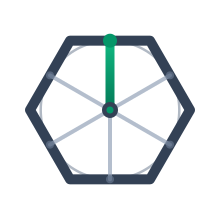
The name encodes the architecture. In geometry, an apothem is the perpendicular from a regular polygon's center to the midpoint of one of its sides — the single distance from the core to every edge, identical along every direction. That is the design: one shared profile at the center, seventeen equidistant harnesses on the perimeter, every materialization the same length away from the source of truth. The core does not change when an edge changes; the edges share a single relationship to the core. Drift is structurally impossible.
Portability guarantees
Rules marked portability: universal are guaranteed translatable to every
supported harness. Rules marked portability: project-specific may require
per-harness override documentation in the rule body.
Concepts
Apothem concepts — the ideas behind the tool: host-agnostic posture, cognitive identity, audit review, and seriousness tiers.
Resumable planning
How Apothem externalizes working state to a project-local .apothem/plans/ suite so long-running work survives session, account, and machine boundaries.